

Big data is put to use more and more to offer customers a better service. But in the off-highway industry it will soon drive the way products are designed and manufactured.
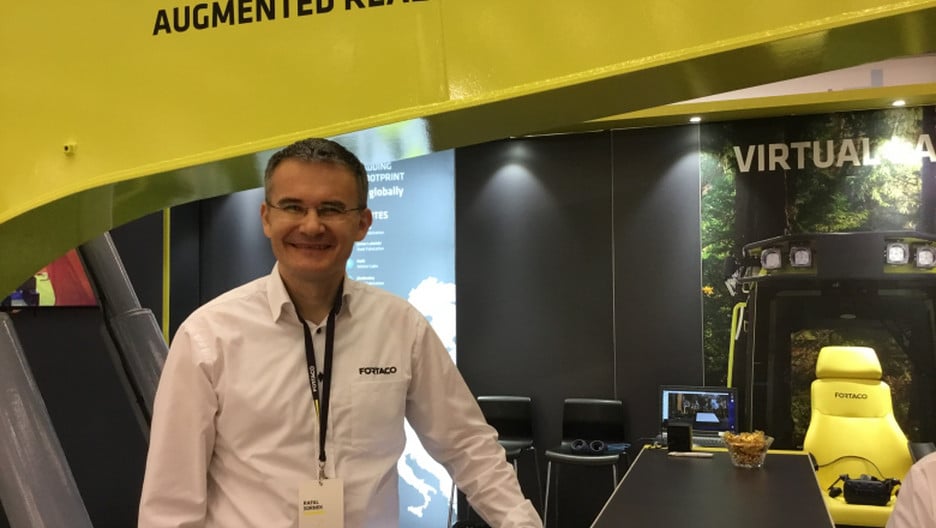
by Dr. Rafal Sornek, Senior Vice President, Fortaco Technology
——-
In 1998, the American car insurance company Progressive launched its Snapshot program. Drivers could opt to place a self-contained autonomous electromechanical sensor (telematics) in their car which would send Progressive a picture of the driver’s habits. In the beginning, the program was used to reward safe drivers with discounts.
In 2013, the company went a step further and used collected data to penalize bad drivers. They measured speed, time spent driving, and recorded incidents of hard braking. The data could tell Progressive whether a driver took risks and whether he (or she, though data shows women are safer drivers) paid attention.
The Progressive case is perhaps the most famous example of how a service company utilized big data to dramatically improve its consumer offering. It’s not often that big data is used to improve manufacturing – but that day is coming soon. I should know: it’s my company that’s pioneering it.
Your million-cycle forklift
In today’s off-highway vehicle manufacturing business, vehicles are manufactured for the most demanding use case. The forklift in your warehouse, for example, likely contains steel components which enable it to run millions of cycles, operating 24/7 to offload thousands of pallets.
But it’s also quite possible that your business doesn’t require that. Perhaps you use your forklift once a day when the truck comes with your delivery. You start it up, offload one pallet, and park it for the rest of the day. Do you really need a forklift with a fatigue life made for the million-cycle customer? What did you pay for that forklift? And how enthusiastic are you about paying to offset the design costs that are not really applicable to your needs?
Today, the steel components in your forklift are made for the most demanding use case. But they won’t be for long. Because big data is changing the way we manufacture.
The digital toolchain
Much like the Progressive Corporation gathers information about its drivers, big data and the digital toolchain enables us to gather information about forklift users.
The fleet management system provides our OEM customers with data about how their customers are using equipment. Is it once per day? Or is it thousands of times per day? Is the end customer utilizing the product’s full lifting capacity? Or only 10 percent of it? Are they utilizing the forklift’s extension boom, or simply taking something off a truck and putting it on the ground?
Next we quantify the data. What portion of our OEM’s customers are light users and how many are heavy? Is it a normal distribution, or are there peaks? If we find that 90 percent of customers are light users, how do we translate that into product architecture? How many product versions do we now need knowing what we know?
RapidSteel
The era of data-driven product design and production is not far off. In fact, at Fortaco we have already begun the process. This year we were the recipients of a research grant for a project we call RapidSteel. It’s a 1.6 million-euro research project, half financed by us, half by the Polish government, which will be used to pioneer data-driven product design for one of Fortaco’s top OEM customers.
It’s a three-year project. This year we’re using data analytics to simulate production options. Next year we’ll build the pilot line which can handle multiple product versions. In year three, we will validate those prototypes in the field.
Customization is coming
I believe that this type of manufacturing in the off-highway industry is inevitable. Whether we like it or not, the reality is that we’ve got to learn how to manage it.
Even in the automotive industry the legacy of Henry Ford is coming to an end: No longer are customers satisfied with any color they want as long as it’s black. Sure, mass production makes sense for cars that carry you from point A to point B –car sharing fleets, for example. But premium cars will have highly-customized “car content,” from the engine to the entertainment system.
Last year, Porsche said that electric vehicles are among the reasons its suppliers will have to work with a modular approach. Electric off-highway equipment will present particular opportunities for the use of big data. Since electric vehicles are powered by expensive nickel batteries, every kilo reduction in the weight of the steel structure results in huge long-term savings for the customer.
No one knows how fast the development of electric equipment will proceed, but we do know manufacturers will be required to provide both diesel and electric offerings in the near- and medium term. This doubling of product offerings can only be made efficient through the use of big data.
Communication is key
The Progressive Corporation’s use of data was so innovative that it changed an entire industry. Competitors eventually discovered that if they weren’t able to offer a similar product, they’d become a niche player serving mainly reckless drivers.
What has already happened in the insurance industry is happening now in the off-highway industry. The modular factory is coming, and big data is its driver.
In the past, OEMs sent us a drawing. This was the communication of a solution, not a need. In this new era, big data is communication – a seamless flow of information which removes opinion or conjecture from product design and manufacturing. It’s communication that cannot be ignored, and communication that allows Fortaco to deliver solutions that serve both your customers and your bottom line.